Bring the blackboard to life.
Physicist Richard Feynman could make physics feel understandable in a lecture hall. Reconstructing it afterward was another matter. When physicist Kip Thorne later asked former Caltech students about Feynman’s course, he heard memories of exhilaration alongside a familiar frustration: the reasoning that had seemed clear in the room could disappear when they tried to work through it alone. [1]
“I found the lectures exciting and understandable in the hall, but they were Sanskrit outside”
A former student, recalling Feynman’s lectures to Kip Thorne [1]
- The ambition
Give beginners something worth reaching for.
Feynman wanted students to encounter the ideas that had drawn them to physics. Why spend years waiting to reach quantum mechanics? He tried to explain its principles before students had learned the differential equations usually required. He also distinguished an idea they could deduce from earlier work from an idea being introduced for the first time. That distinction told a learner where to keep reasoning and where a new starting point was needed. [2]
- The missing book
Keep the thinking after the chalk is gone.
There was no matching textbook students could open to recover the lecture. Physicist Matthew Sands had proposed recording Feynman and turning the lectures into the course’s text. The team initially expected a little editing that graduate students could do part time. Robert Leighton, another physicist on the project, recalled what actually happened: each lecture needed ten to twenty hours of a physicist’s attention to become readable. [1][3]
Feynman, Leighton and Sands worked from recordings and photographs of the blackboards, expanding and editing the material into three volumes. The captured lecture became an argument a reader could pause, retrace and work through. The Feynman Lectures on Physics went on to serve generations of students far beyond the original classroom. [1]
- The work of learning
Find the exact step you need to understand.
Feynman himself judged the course partly by whether students could solve problems. A memorable performance was only one part of their education; the course also included small discussion groups and laboratory work. In his preface, he returned to the value of students thinking through ideas and discussing them with a teacher. [2]
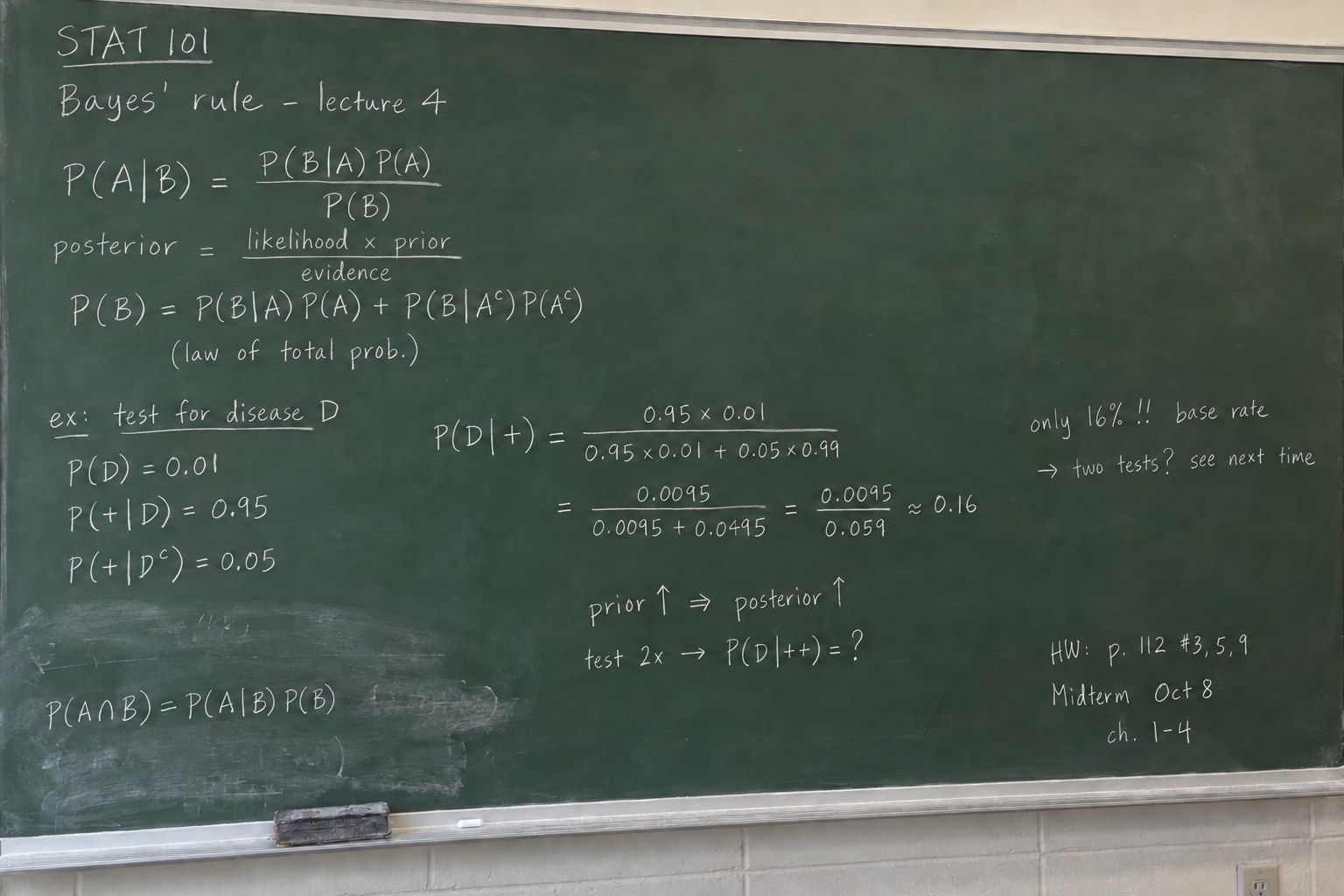
That is the opportunity in keeping a usable account of your own board. The question about two positive tests remains open, exactly where the lecturer left it. You can work through the argument and bring a precise question back to class.
Feynman’s team made a fleeting lecture available for years of further thought. Longhand gives your own board work a life after class: the notation you need and the questions still waiting for an answer. Keep the photograph with the note, return to the difficult passage and work through it until you can use the idea yourself.